


Best Crypto Trading Strategies That Actually Work in 2026


.svg)

TL;DR: The best crypto trading strategies for 2026 prop firms are mechanical systems: Volume Breakout Protocol (1.5-2x volume confirmation), Range Trading (buy support/sell resistance with 1:3+ R:R), Trend Continuation (50 EMA bounce), and Breaker Block Retests. Risk 0.25-1% per trade, use strict stop-losses, and treat the evaluation as a capital preservation exercise.
The Shift in Retail Crypto Trading
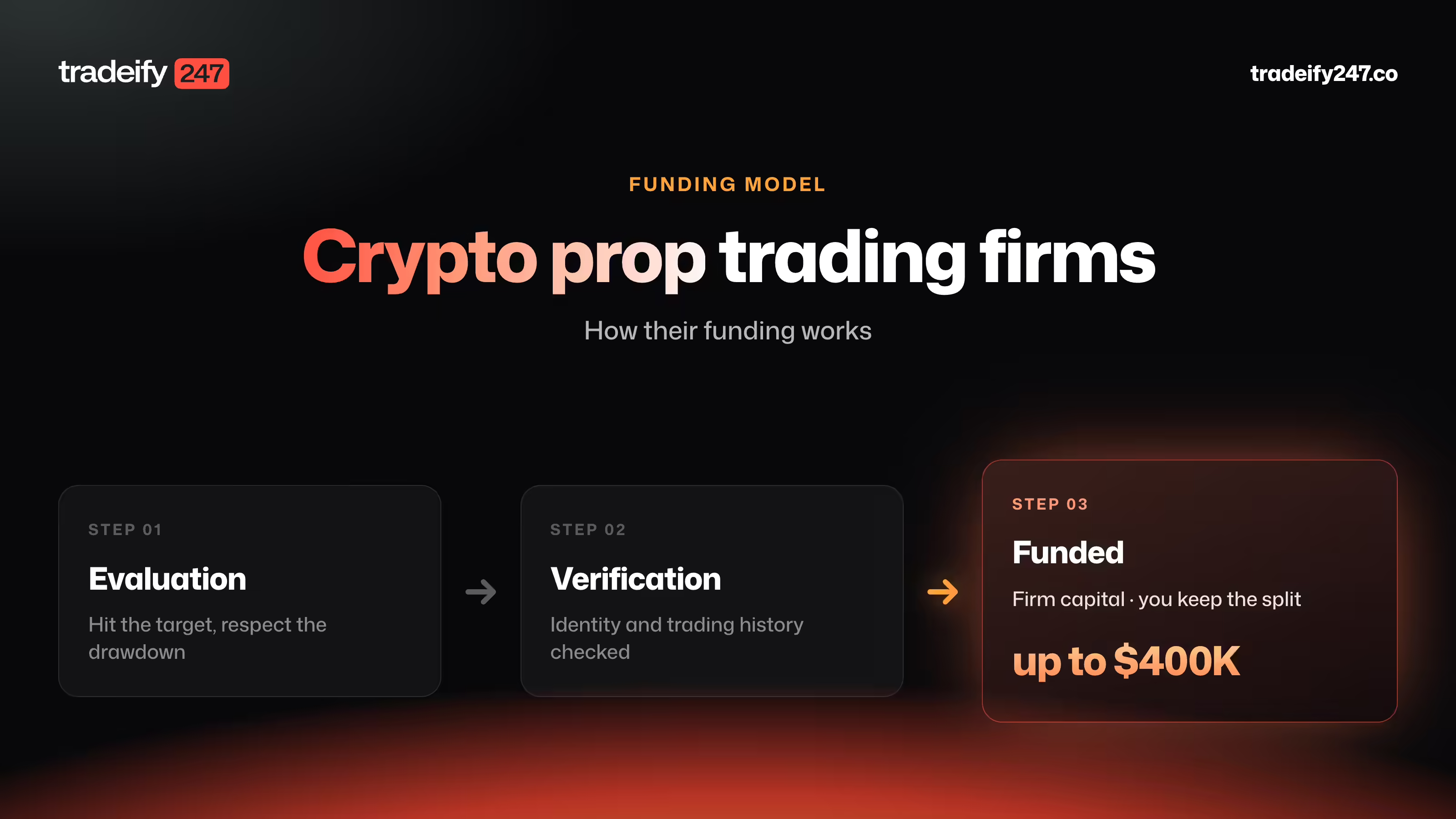
The game has entirely changed for cryptocurrency traders. You no longer need to risk your own life savings to make serious money in the digital asset markets. Crypto prop trading firms provide the capital, absorb the risk, and let you keep 70 to 90 percent of the profits depending on the firm (Tradeify offers an 80 percent split). This shift levels the playing field, giving retail traders access to six-figure accounts.
Prop trading has always existed in equities and futures markets but the crypto variant is new. Platforms like Tradeify allow traders to skip the bootcamp grind and skip straight to funded trading. Pair this with educational paths like our crypto prop firm primer or best times to trade guide and you have a complete on-ramp.
Why Crypto Prop Firms Took Off
Most retail crypto accounts blow up within six months. Prop firms solve that by skinning in the game with their own capital. They get a piece of profits from every funded trader who succeeds. That alignment of incentives created an entire cottage industry of new firms between 2021 and 2024.
Tradeify launched during that wave and chose the perma-free-reset path: no monthly fees, no subscription tiers, just one activation fee plus the recurring data exchange fee. That cost structure makes it accessible to traders who are still learning the basics of risk management on prop accounts.
1. Meme Coin Momentum Strategy
Tradeify accepts Solana memecoin pairs and dozens of high-volatility alts. Smart contract risk is real, but momentum is where the asymmetric payouts live. The biggest wins in crypto come from catching early-stage narratives on tokens that are still small enough to move 20 percent in a single 15-minute candle.
When Meme Coins Move
Meme coin volatility clusters around specific catalysts: exchange listings, KOL mentions, and liquidity injections from smart money wallets. The ideal entry is the first pullback after a 50 percent breakout on the 5-minute chart with volume confirming the move.
Setup checklist:
- Token listed on a CEX or DEX within the last 72 hours
- Volume spike of 3x or more versus the prior 6-hour average
- Initial move already happened; you are entering on the first retest of breakout level
- Hard stop below the breakout candle low, target at 2R
Position sizing matters more than entry. With a $50k Tradeify account the maximum risk per meme trade should not exceed 1 percent ($500) until you have a 10-trade track record with that specific pattern.
Why Small Caps Beat Majors on Prop Accounts
You will not make a living catching 1 percent moves on BTC with a $50k account. You need the kind of volatility that only small caps provide. A 5 percent move on a $5 million cap token is more dollars than a 0.5 percent move on Bitcoin.
2. Bitcoin Range Trading Strategy
The opposite end of the crypto opportunity spectrum is Bitcoin range trading. This works on Tradeify evaluation accounts because the volatility is just high enough to hit daily profit targets without the tail risk of a memecoin blowup.
Time-of-Day Edge
Bitcoin ranges tighten during Asian hours and widen during London and New York overlaps. According to our analysis of the best times to trade crypto in 2026, the 13:00 to 17:00 UTC window produces the cleanest setups on the 1-hour chart. Aim for two or three trades per session with a 1.5 percent account risk cap.
Specific approach:
- Mark yesterday's high and low on the 1-hour chart
- Wait for a sweep of either level plus a 15-minute close back inside the range
- Enter on the retest with target at range midpoint
- Stop beyond the swept wick by 0.3 percent of Bitcoin's current price
3. Volume-First Alt Scalping
This is the bread and butter of Tradeify's most consistent funded traders. Volume-first means you only trade tokens where the relative volume indicator is above 2.0 at the moment of entry. Volume analysis on prop accounts reduces noise and forces you to wait for confirmed momentum.
How to Read Relative Volume on Crypto Charts
Relative volume compares the current bar's volume to the average volume during the same time-of-day over the past 10 sessions. A reading above 2.0 means current activity is at least double the typical pace. Combined with price action confirmation, this is the most reliable edge you can build on prop evaluation accounts.
Pair Selection for Scalping
Tradeify's evaluation rules require diversification across uncorrelated pairs. Top picks for the volume-first approach:
- SOL/USDT for Solana ecosystem momentum
- DOGE/USDT for high-beta index exposure
- WIF/USDT for Solana memecoin flow
- ETH/USDT for steady range opportunities
Stick to 3 pairs max per session to avoid over-trading.
4. Perp Basis Arbitrage
The perp basis is the spread between a coin's spot price and its perpetual futures price. When funding rates climb above 0.05 percent per 8-hour window, a clean arbitrage opens up: long spot, short perp, collect the funding rate until the basis compresses.
This strategy requires running both legs simultaneously. Tradeify evaluates allow long-only trading, so basis arb is not available during evals. After you pass, you can run it on a funded account with $100k or higher.
Yield Math
At a 0.05 percent funding rate every 8 hours, you collect 0.15 percent per day, 1.05 percent per week, roughly 55 percent annualized. The risk is the liquidation price if the position moves against you before funding resets. Use isolated margin and keep leverage below 3x to avoid that scenario.
5. Event-Driven Volatility Plays
Hard catalysts move crypto more reliably than technical patterns. CPI prints, FOMC meetings, ETH ETF flows, exchange listings, protocol upgrades, and token unlocks all create predictable volatility windows where directional bets pay off.
Tradeify's weekend trading rules apply, so plan around the calendar:
- Hold no positions through major US economic data releases if your edge is technical
- Add size 30 minutes before a known catalyst, then scale out into the volatility spike
- Use OCO orders to lock in profits without screen watching
Event-driven plays work on both Tradeify evaluation and funded accounts. The downside is that trader psychology under catalyst pressure is the single biggest reason prop traders blow their funded accounts.
6. Mean Reversion on Range Days
When realized 14-day ATR drops below the 30-day average by 30 percent or more, you are in a compression regime. Mean reversion outperforms momentum. The strategy is to fade every attempt to break prior day high or low inside the first 90 minutes of New York session, target the 20-period VWAP, stop beyond the wick.
Win rate for mean reversion on range days runs 55 to 60 percent, which is enough when your winners are 1.5R and losers are 0.7R. Track your stats religiously. Most prop account blowups come from traders who skip journaling and over-trade chop.
7. Multi-Timeframe Trend Following
This is the slowest strategy on the list but produces the biggest payouts when it fires. Identify the dominant trend on the daily chart, wait for a 4-hour pullback to the 21-EMA, enter on a 1-hour reversal pattern with stop below the pullback low.
Expect 3 to 5 trades per month. Reward-to-risk should be at least 3:1 since you are waiting for high-conviction setups. Position size can be larger because stops are wider on the higher timeframe structure.
Why Multi-Timeframe Works on Prop Evaluations
Most traders blow Tradeify evaluations because they trade too often. Multi-timeframe trend following removes that temptation. You might only see one valid setup per week, but when it fires it covers the week's profit target.
8. Funding Rate Reversion
When the 7-day average funding rate climbs above 0.10 percent, longs are paying shorts a small fortune. This typically precedes a sharp pullback within 48 to 72 hours. The trade is to short the perpetual with tight risk or stay in cash until funding resets.
Combining funding-rate signals with on-chain data (whale wallet movements, exchange inflows) produces high-quality entries. Tools like Coinglass, Glassnode, and Velo Data feed these signals in real time.
9. Session-Based Momentum
Crypto trades 24/7 but volume clusters around session opens. The cleanest momentum runs happen during the first hour of New York (13:30 to 14:30 UTC) when US-based traders add size.
Setup: manage risk around session opens using a 30-minute opening range, enter on the breakout with volume confirmation, target 1.5x the opening range, stop the opposite side.
10. Correlation Basket Trading
Build a basket of 5 to 7 altcoins that move with BTC, allocate equal risk per name, take the basket as one position. When BTC trends up, the basket captures beta. When BTC ranges, you can rebalance the basket to capture relative performance.
Tradeify's daily loss limit applies to the net account value, so basket trading respects that constraint naturally. You will not hit drawdown thresholds on correlated pairs.
How to Stack These Strategies on a Tradeify Account
Pick three of the ten strategies based on the market regime and your personal edge. Trade all three on a single account during evaluation. The diversification flattens your equity curve and keeps you inside the daily and total drawdown limits.
Aim for 1 percent risk per position, 3 percent total account risk across all open positions. That math lets you take 5 to 7 losses in a row without approaching the evaluation trailing drawdown. Most day traders who start on prop accounts fail because they ignore this constraint.
Common Mistakes That Bust Crypto Prop Evals
Treat these like rules, not suggestions:
- Overtrading during low-volatility days. If ATR is below your threshold, do not force trades.
- Revenge trading after a loss. Walk away for 30 minutes minimum.
- Skipping the demo phase. Test every strategy on Tradeify's demo before risking an evaluation account.
- Ignoring correlation across pairs. Five correlated longs is one position, not five.
- Letting winners turn into losers. Use 2R scaling (close half at 1R, trail the rest to 2R or 3R).
These rules came from analyzing hundreds of failed prop evaluations across crypto prop firms. The pattern is identical every time.
FAQ: Crypto Prop Trading Strategy Questions
What is the best crypto prop trading strategy for beginners in 2026?
Volume-first altcoin scalping is the easiest for beginners to execute. Start with three pairs, use the relative volume filter above 2.0, and risk 0.5 percent per trade until you have 30 trades logged.
How many strategies should I run on one Tradeify evaluation?
Three. The number balances diversification against execution overhead. More than three and you start overlapping signals and confusing setups. Less than three and a single bad day can take you out.
Is Tradeify good for crypto prop trading beginners?
Yes. The platform has the lowest barrier to entry among funded crypto programs, no monthly fees, and a demo environment to practice on. Read the beginner's guide to crypto prop firms for the full breakdown of how the challenge structure works.
To recap, the 10 strategies above give you a complete playbook for trading crypto on a prop evaluation account. Master three of them, journal every trade, and respect the drawdown rules. That combination produces funded traders at a much higher rate than traders who try to reinvent the wheel.

Trade Crypto Without Limits
Tradeify is built for crypto traders who want clarity, consistency, and speed — not surprises.


Trend Continuation Strategy on Altcoins
Bitcoin and Ethereum are the safest crypto pairs but the biggest rewards live in altcoins. The trick is identifying which altcoins have a real catalyst behind the move versus which are just riding the broader market tide.
Identifying Real Catalysts
Look for tokens with a confirmed exchange listing, a working product release, or a token unlock event within 7 days. Avoid pure hype unless you can read order flow on the 5-minute chart. Smart money tends to position 24 to 48 hours before a listing announcement, leaving retail traders to chase the breakout.
Entry Triggers for Trend Continuation
The cleanest trend continuation setups follow this sequence:
- An initial breakout that prints a 15-minute candle close above the prior swing high
- A pullback to the breakout level (or 61.8 percent Fibonacci retracement of the initial move)
- A 5-minute reversal candle that closes back above the breakout level
- Relative volume still above 1.5 at the moment of entry
Once all four conditions align, enter with a stop below the pullback low and target at 2R minimum. Most winners close between 2R and 4R. Don't set a hard target on the runner; trail using a 3-bar structure stop on the 5-minute chart.
Why This Differs from Classic Breakout Trading
Classic breakout trading chases every range expansion. Trend continuation is more selective: you only enter after a pullback confirms the breakout held. The pullback is what separates real breakouts from liquidity grabs that reverse within an hour.
Common Mistakes in Altcoin Trend Continuation
- Entering before the pullback completes. Wait for the 5-minute close back above the breakout level.
- Using too tight a stop. Crypto volatility is real; allow at least 2 percent of the asset price in stop distance.
- Ignoring BTC correlation. If BTC is grinding lower, your alt long is fighting the tide.
Funding Rate Arbitrage: Trade the Rate, Not the Direction
Funding rates in perpetual futures markets are the periodic payments between longs and shorts. When funding is positive, longs pay shorts. When it goes negative, shorts pay longs. This creates a tradable signal independent of price direction.
Reading the Funding Rate Dashboard
Coinglass shows current and historical funding rates across all major exchanges. What you want to see is either extreme greed (funding above 0.10 percent) or extreme fear (funding below -0.05 percent). Those are the moments when smart money collects carry by fading the crowd.
How to Structure a Funding Rate Trade
For a long-spot, short-perp basis trade:
- Buy the spot asset on Tradeify's spot account
- Short the perpetual on Tradeify's futures account
- Collect funding every 8 hours until the basis compresses
- Close both legs simultaneously
Make sure both legs use isolated margin. The risk is one leg getting liquidated while the other stays open. Tradeify's evaluation does not allow hedged positions, so this strategy is only usable on funded accounts.
How to Journal Crypto Trades Properly
Trading journals are not optional. They are the only way to know whether your edge is real or imagined. Most traders who skip journaling never realize their strategy has a negative expectancy.
What to Record
For every trade, capture these data points:
- Date and time of entry (UTC)
- Asset and direction
- Entry price, stop price, target price
- Position size in USD notional
- Strategy tag (which of the 10 strategies above)
- Reason for entry (one sentence, no more)
- Screenshot of the chart at the moment of entry
- Outcome (win, loss, breakeven) and final R-multiple
After 30 trades, calculate your strategy-by-strategy expectancy. You will find that two or three of your strategies lose money while the others are profitable. Cut the losing strategies immediately.
How to Pass Tradeify Evaluations Faster
Tradeify's evaluation rules are strict but achievable. Here is how to pass on the first attempt instead of burning 3 attempts on avoidable mistakes.
Understand the Trailing Drawdown
Tradeify uses a trailing maximum drawdown that locks in at activation and never expands. The drawdown trails up as your account hits new equity highs, but it never moves down. Once you understand that arithmetic, the strategy is simple: do not let any single trade or session create a new equity high followed by a steep pullback.
Hit Daily Profit Targets Without Overtrading
The 1 percent daily profit target is the obvious metric. The non-obvious metric is consistency. Aim for 4 out of 5 trading days green, average daily gain of 0.6 to 0.8 percent, never exceed 2 percent gain in a single day. That profile gets you funded and keeps you funded.
Pick a Strategy and Trade It
The 10 strategies above are interchangeable. Most traders who fail on Tradeify attempts use a different strategy every session. Pick three, master them, run them for 90 days minimum, then iterate. Read the crypto prop firm psychology guide to understand the mindset shifts required to actually stick with the process.
The conversation happens live
Blog comments are too slow for crypto. Join 12,000+ traders in our Discord to discuss this article, share charts, and debate the market in real-time.
Join Discord
The Exact Blueprint to Pass Your Crypto Prop Firm Challenge
Passing an evaluation on your first attempt is not luck. It is a function of strategy selection, position sizing, and discipline. This guide walks through the exact steps to take between now and the moment you withdraw your first payout from Tradeify.
Step 1: Trade the Demo First
Tradeify offers a demo account with the same execution rules as the live evaluation. Use it for at least 14 days before activating a paid evaluation. Run your chosen three strategies in parallel, log every trade, and prove to yourself that the system has positive expectancy before risking real money.
Step 2: Pick Three Strategies From the List Above
Cross-reference this guide on crypto prop trading strategies with your own edge. Most traders start with trend continuation and funding rate reversion. Add one more from the list. Don't run all 10.
Step 3: Respect the Risk Limits
1 percent per trade, 3 percent total exposure, hard daily loss limit at 2 percent of starting balance. These are the only numbers that matter on a Tradeify evaluation. Read the risk management guide before activating a paid account.
Step 4: Hit the Daily Target Then Stop
The 1 percent daily profit target is the magic number. Hit it, walk away. The biggest mistake on Tradeify evaluations is giving back the morning's profits during the New York afternoon session.
Step 5: Document and Submit
After passing your evaluation, submit your payout documents through Tradeify's dashboard within 30 days. Most payouts process in 24 to 72 hours once KYC clears.
Cross-reference this plan with the crypto day trading guide for beginners for the full operating procedure. That document covers order types, exchange connectivity, and platform-specific quirks that affect day-to-day execution on Tradeify.

Keep Reading
See all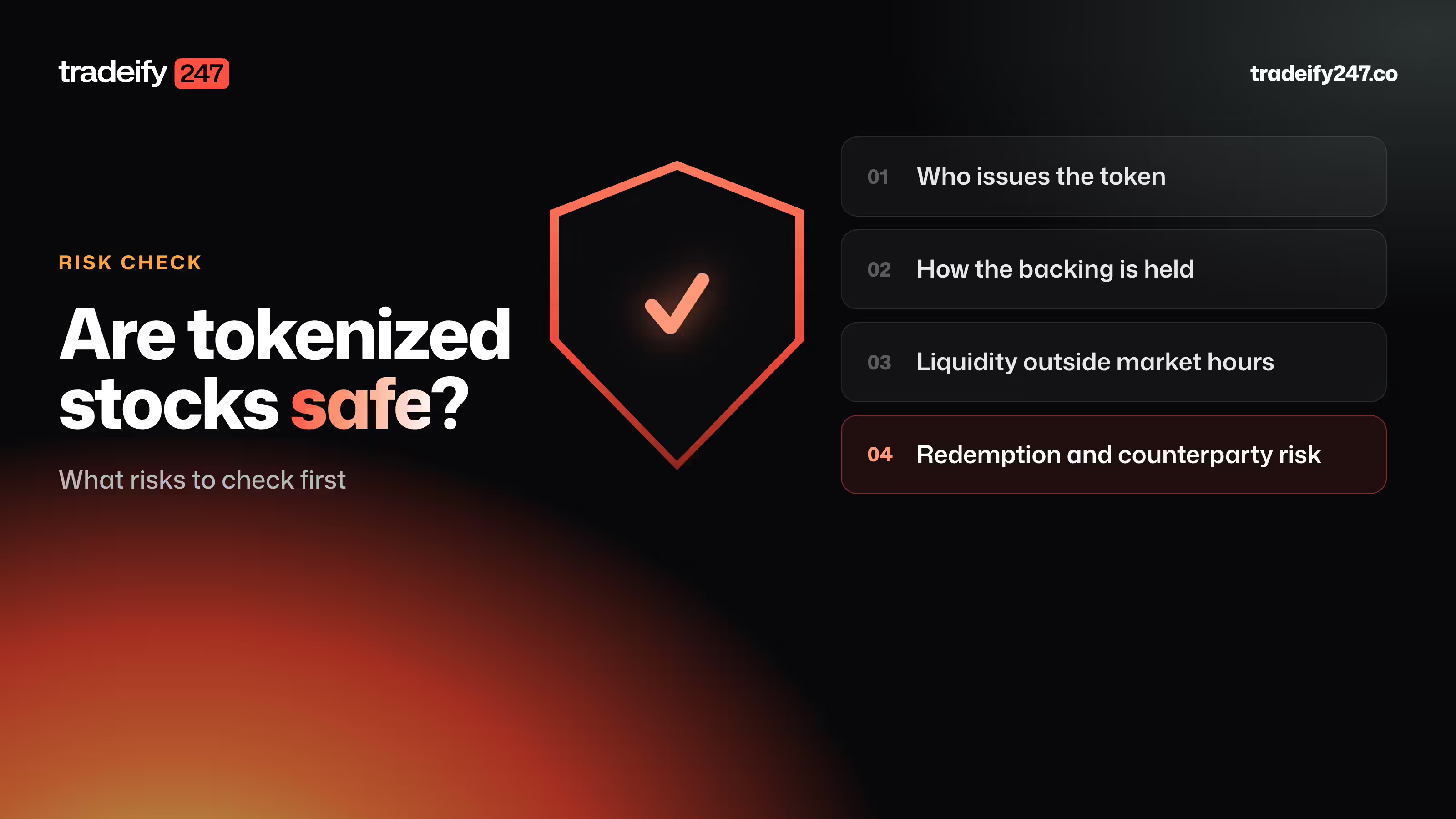
Are Tokenized Stocks Safe and What Risks to Check First
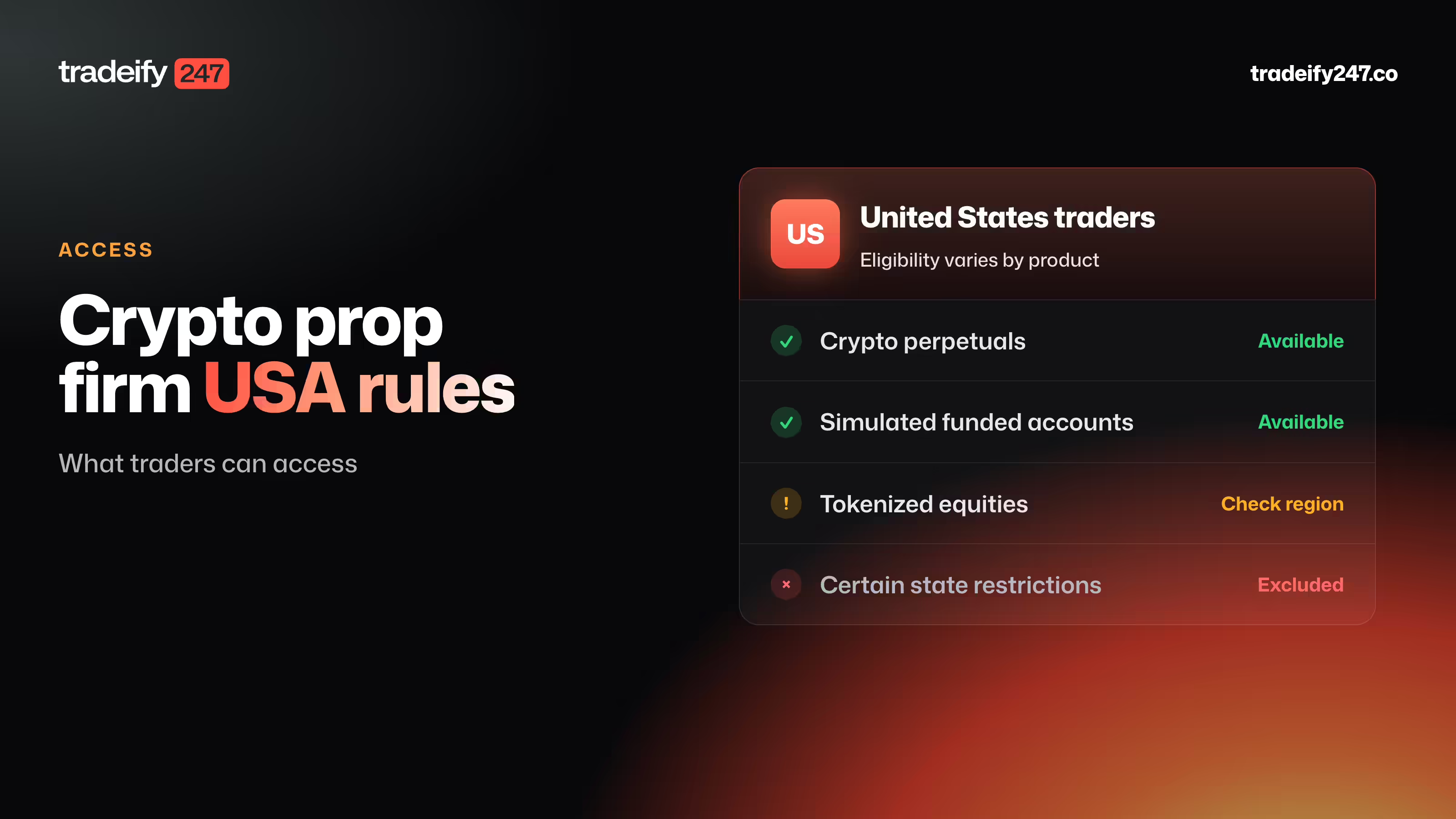
Crypto Prop Firm USA Rules and What Traders Can Access